Washington's September action is the broadest it has taken against Iranian aviation, and it is already biting. History says it will shrink the network and raise its costs. It also says the network will look for ways around it, and most of those ways are already known.
Three 777s, delivered while Washington prepared
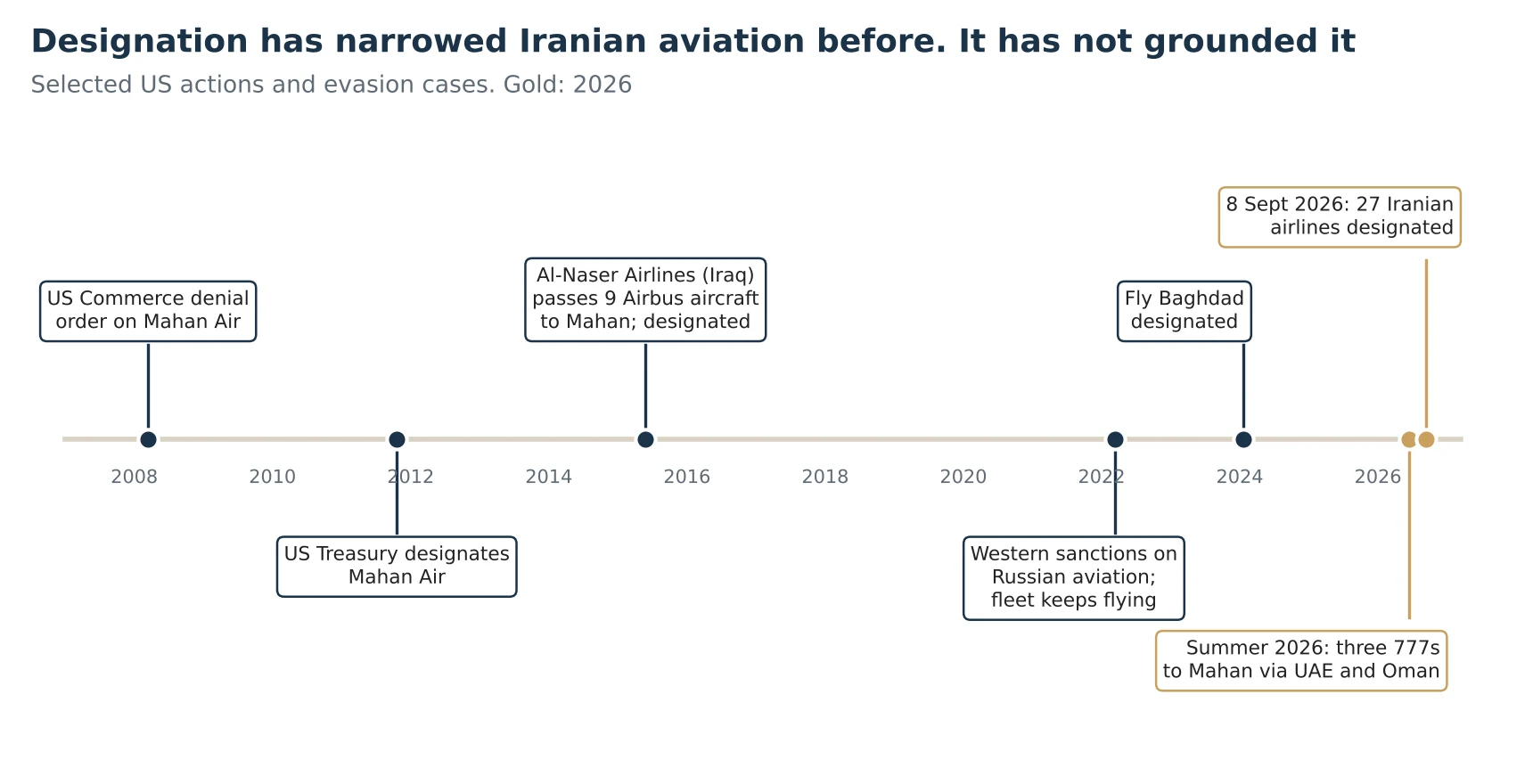
When the US Treasury designated 27 Iranian airlines on 8 September, its announcement contained a detail that deserved more attention than it got. That summer, Treasury said, Mahan Air had obtained at least three Boeing 777s taken from retired fleets. The aircraft were routed through the UAE and Oman, given temporary registrations by a UAE company, ECT Aviation Support, and passed on to Mahan through intermediaries. Treasury described the pattern as a repeat of earlier evasion schemes.
In other words, while Washington was preparing its broadest action yet against Iranian aviation, the most heavily sanctioned airline in the country, under US measures since 2011, was adding wide-body aircraft to its fleet.
Our 2 October brief recorded who has complied since the deadline passed on 23 September and what is still flying. This piece looks at the next question: how well the measures are likely to work, and what the network will do in response.
What makes this action different
Earlier US measures picked off individual carriers and the people supplying them. This one designated almost the entire sector at once, alongside foreign facilitators of Mahan in the UAE, the UK, Türkiye, Malaysia and Kazakhstan, and suspended the general licence that let non-US airlines fly US-origin aircraft to Iran. The target is no longer only the airlines. It is everyone who serves them: fuel suppliers, ground handlers, ticketing agents, lessors, maintenance shops, insurers and the banks behind all of them.
Washington's stated aim is to cut off a sector it says the Islamic Revolutionary Guard Corps uses to move weapons, personnel and money. Mahan in particular has been accused by the US for years of flying for the IRGC's Quds Force and for Hezbollah.
The criticism is just as concrete. Iraq has asked Washington for a humanitarian exemption for patients, students and pilgrims, some of whom now face land journeys of more than twelve hours. A second concern is safety. An ageing fleet, already damaged in the war, now has fewer legal routes to parts and maintenance. Sanctions that push airlines towards improvised maintenance carry a risk that falls on passengers, not on the people the measures target.
Measuring whether it works
Efficiency has to be measured against what the network looked like before. Iran's international aviation was already shrinking fast. In the year before the action, according to Aviation Week, Iranian international seat capacity fell by 69%, from about 418,000 to 129,000 scheduled seats, and the network contracted from 88 international routes in 17 countries to 27 routes in 11. Around 100 Iranian airliners were reported destroyed or damaged in the conflict. China, Türkiye, Iraq and the UAE together accounted for 92% of what remained.
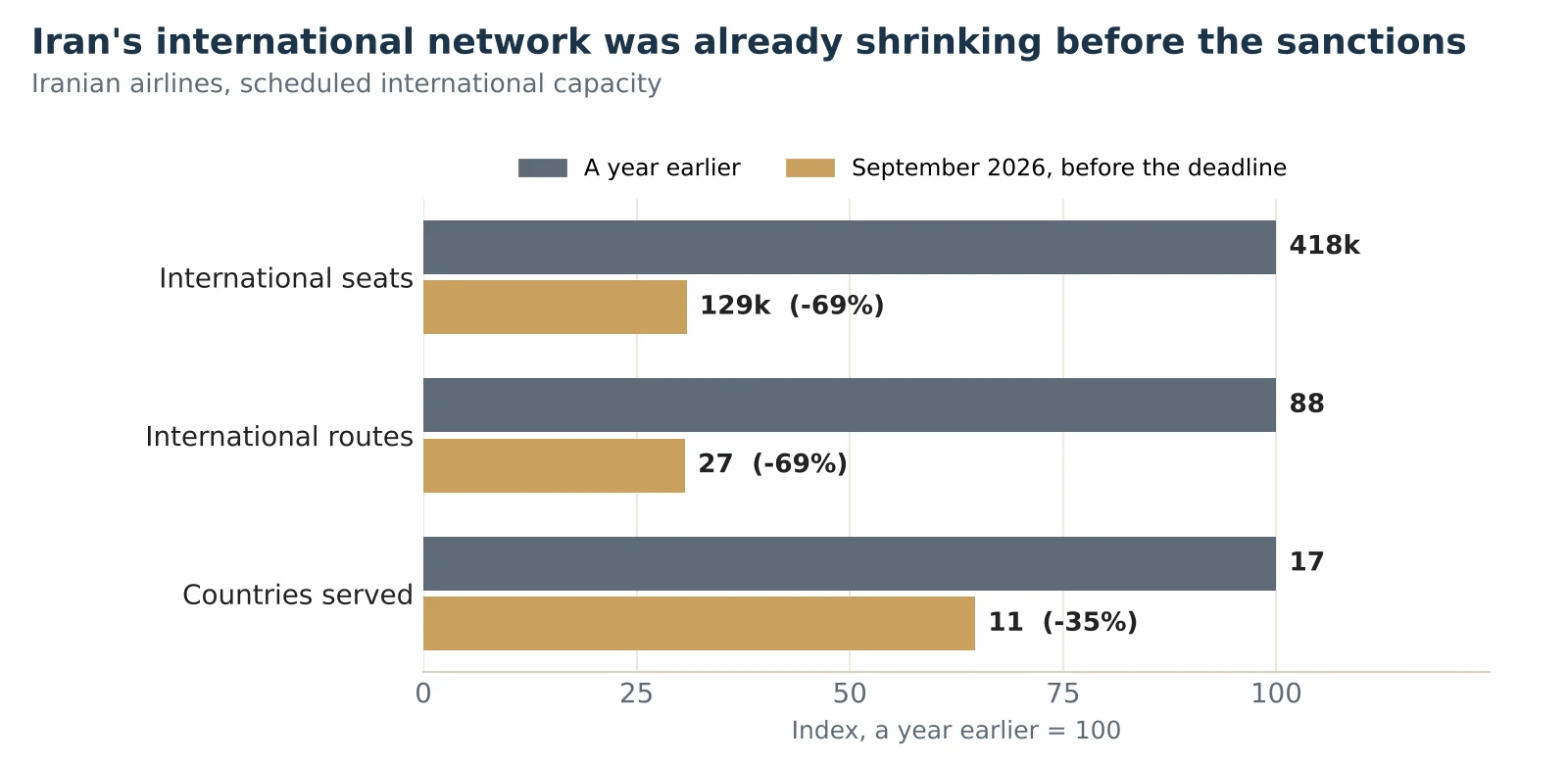
That concentration is the key to reading the sanctions. With the UAE closed and Iraq largely closed, Iran's international network now depends overwhelmingly on Türkiye and China, with Russia, Armenia and Central Asia behind them. The sanctions are as effective as the weakest of those links is willing to be.
The early evidence points to three different levers, and they are not equally strong. Government bans matter where they happen, but several governments have avoided formal decisions. Private refusals have done more: in Iraq, the ambassador said ground handlers stopped serving Iranian aircraft for fear of sanctions before the government decided anything. The third lever is commercial: a Turkish services firm used a court order over unpaid fees to hold an Iranian aircraft in Istanbul, in a country that has not banned Iranian carriers. Each refusal by a supplier is a small decision. Together they ground more aircraft than any single ban.
History is less encouraging for anyone expecting a full grounding. The US Commerce Department first placed Mahan under a denial order in 2008, and Treasury designated it in 2011. Fifteen years later it is still Iran's main long-haul carrier. In 2015 Treasury found that Iraq's Al-Naser Airlines had passed nine Airbus aircraft to Mahan after buying them from European sellers. In January 2024 it designated another Iraqi carrier, Fly Baghdad, accusing it of flying for the Quds Force. Russia's airlines, cut off from Western manufacturers since 2022, are still flying four years later, although Ukrainian intelligence claims more than a third of the civil fleet has been stripped for parts.
Where the network is most likely to go next
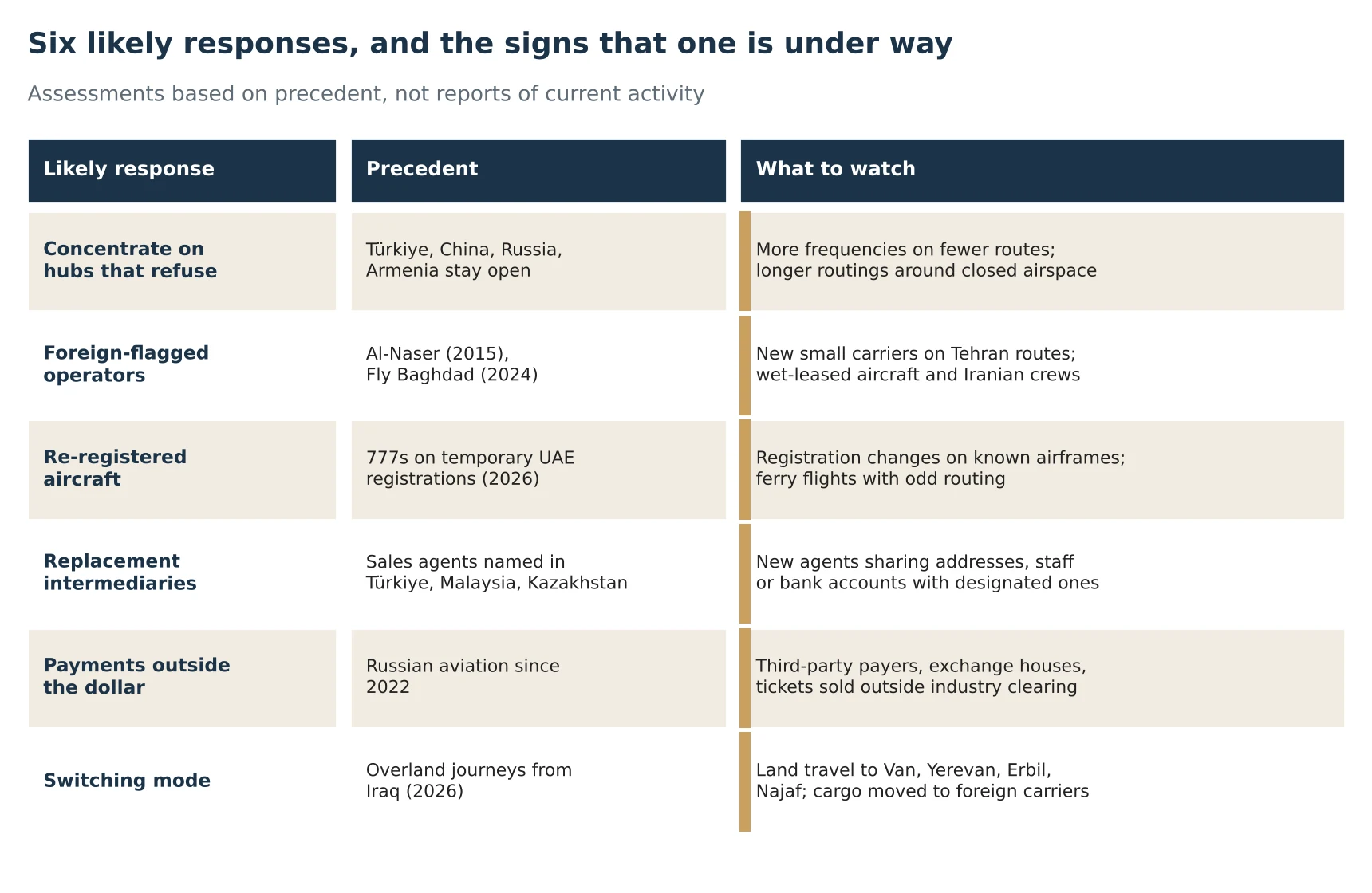
Based on those precedents, six responses are likely. None is new. What will change is where they happen and who carries them out.
Concentration on hubs that refuse to comply. Istanbul for the west, Chinese and Russian airports for long-haul, Yerevan, Dushanbe, Kabul and Central Asian cities for the rest. Expect more frequencies on fewer routes, and longer routings around closed airspace.
Foreign-flagged operators. The most durable workaround has always been an airline that is not Iranian on paper. Al-Naser in 2015 and Fly Baghdad in 2024 show the model. Expect new or small carriers in Iraq, Central Asia or the Caucasus to start wet-leasing aircraft and crews, or flying Tehran routes under their own codes.
Re-registration of aircraft. Aircraft can move from the Iranian register to another country's, as the 777s passed through temporary UAE registrations this summer. A change of registration mark is cheap. The airframe's manufacturer serial number does not change.
Replacement intermediaries. Treasury has named sales agents in Türkiye, Malaysia and Kazakhstan and a procurement company in the UAE. Expect replacements, and expect some of them to share addresses, staff or bank accounts with the companies they replace.
Payments outside the dollar. Fuel, handling and ticket revenue settled in yuan, roubles, lira or dirhams through exchange houses and banks with no US exposure, and tickets sold through travel agencies and online platforms rather than through industry clearing systems.
Switching mode. Passengers travelling overland to Van, Yerevan, Erbil or Najaf and flying on from there with other airlines; cargo moving by sea, road or on foreign freighters.
None of these will restore the network that existed before the war. Each adds cost and delay, and some add safety risk. That is how sanctions of this kind usually work: they tax the activity rather than end it.
What exposed companies should check
For airports, ground handlers, fuel suppliers, lessors, maintenance firms, parts distributors, banks, travel agencies and freight forwarders in the Middle East, Africa and Central Asia, the exposure now sits in routine transactions.
- Screen the airframe, not only the registration. Check the manufacturer serial number and the aircraft's ownership and operator history. A recently changed registration, a gap in tracking history or a ferry flight through an unusual route is a reason to ask more.
- Look behind the operator. A newly certified airline flying older Western aircraft to Tehran, with crews or managers from Iranian carriers, needs a closer look at who owns and controls it.
- Check who pays. Fuel and handling invoices settled by a third party, in a third country, or by an exchange house deserve the same attention as a direct payment from a designated carrier.
- Know your agents. Travel agencies and cargo sales agents that started selling Iranian routes after September, or that took over from designated agents, are an obvious point of risk.
- Use tracking data carefully. Flight tracking shows patterns, not proof. Gaps and unmatched flights are often innocent, as our own monitoring has found. Treat them as a reason to ask, not as a finding.
There are limits. Humanitarian travel is real and some governments are seeking exemptions, so a blanket refusal can carry its own legal and reputational cost. Tracking coverage over Iran and Central Asia is uneven. And a company outside US jurisdiction still has to judge for itself how far secondary sanctions risk reaches its business.
What can only be seen from the ramp
Most of the signals that matter will appear on airport aprons and in back offices, not in sanctions lists. Which handler is now servicing Iranian aircraft at Istanbul or Yerevan. Who settles the fuel invoice. Which travel agencies in Najaf or Almaty have started selling seats to Tehran. Whether a new airline in the region is using aircraft that used to carry Iranian registration marks. Our own 2 October brief ended with a question about a seized Caspian aircraft that only an airport-side source in Istanbul could settle.
People who work at those airports, and in the trade around them, see these changes weeks before they appear in any designation. Combined with tracking data and corporate records, that local view is what turns a pattern into a finding.
The designations removed Iran's airlines from the dollar system in a single day. Whether they leave the sky will be decided on ramps and in ticket offices far from Washington.
Position as at October 2026. Allegations and designations are described as reported; the likely responses are assessments based on precedent. This article does not constitute legal advice.