Federal forces retook Tigray's capital on 4 October, two weeks after the war resumed. The front line has moved, but the risk has not gone away. It has spread onto the roads, fuel supplies and payments that every company in Ethiopia depends on, and the sea route beyond Djibouti has become more expensive at the same time.
Two weeks that changed the map
On 4 October Ethiopian federal forces entered Mekelle, the capital of Tigray. The Tigray People's Liberation Front said it had "temporarily moved out" to operate from elsewhere, and its leader spoke of shifting to "mobile fighting". The government said it would set up a new regional administration and hold elections within months.
The fortnight before showed how far this war has moved beyond Tigray. On 20 September seven armed groups, including the Oromo Liberation Army and factions of the Amhara Fano movement, announced an alliance to remove the government. From 23 September Tigrayan forces seized airports in the north, and Ethiopian Airlines suspended flights to three northern airports. Airports at Semera and Kombolucha were struck on 27 September. On the nights of 30 September and 1 October drones struck targets in and around Addis Ababa, the first known drone attack by anti-government forces on the capital, according to Reuters. On 2 October Eritrea severed diplomatic ties after Ethiopia expelled its diplomats. Three days later the leaders of Egypt, Eritrea, Somalia and Sudan's army issued a joint declaration on the Nile and the Red Sea that took positions directly opposed to Ethiopia's.
A loose coalition, spread thin
The government presents the campaign as restoring federal authority, and the capture of Mekelle supports its claim to be winning. The rebel alliance says openly that its aim is to remove the government. Both sides make claims about territory, casualties and foreign involvement that cannot yet be checked independently. The Council on Foreign Relations' conflict tracker rates the conflict as worsening.
The alliance is less solid than its announcement suggested. Monitoring by ACLED found only three groups actively involved in the northern fighting in late September, and recorded clashes in South Gondar between Fano factions that disagree over cooperating with the TPLF. Chatham House analysts describe the coalition's cooperation as unstable.
For a business, that fragmentation does not reduce the risk. It changes its shape. A front-line war between two organised sides can be planned around. A set of armed groups with different commanders, operating as mobile forces across several regions, produces risk that is local, sudden and hard to predict. It falls on routes, towns and services rather than on one region.
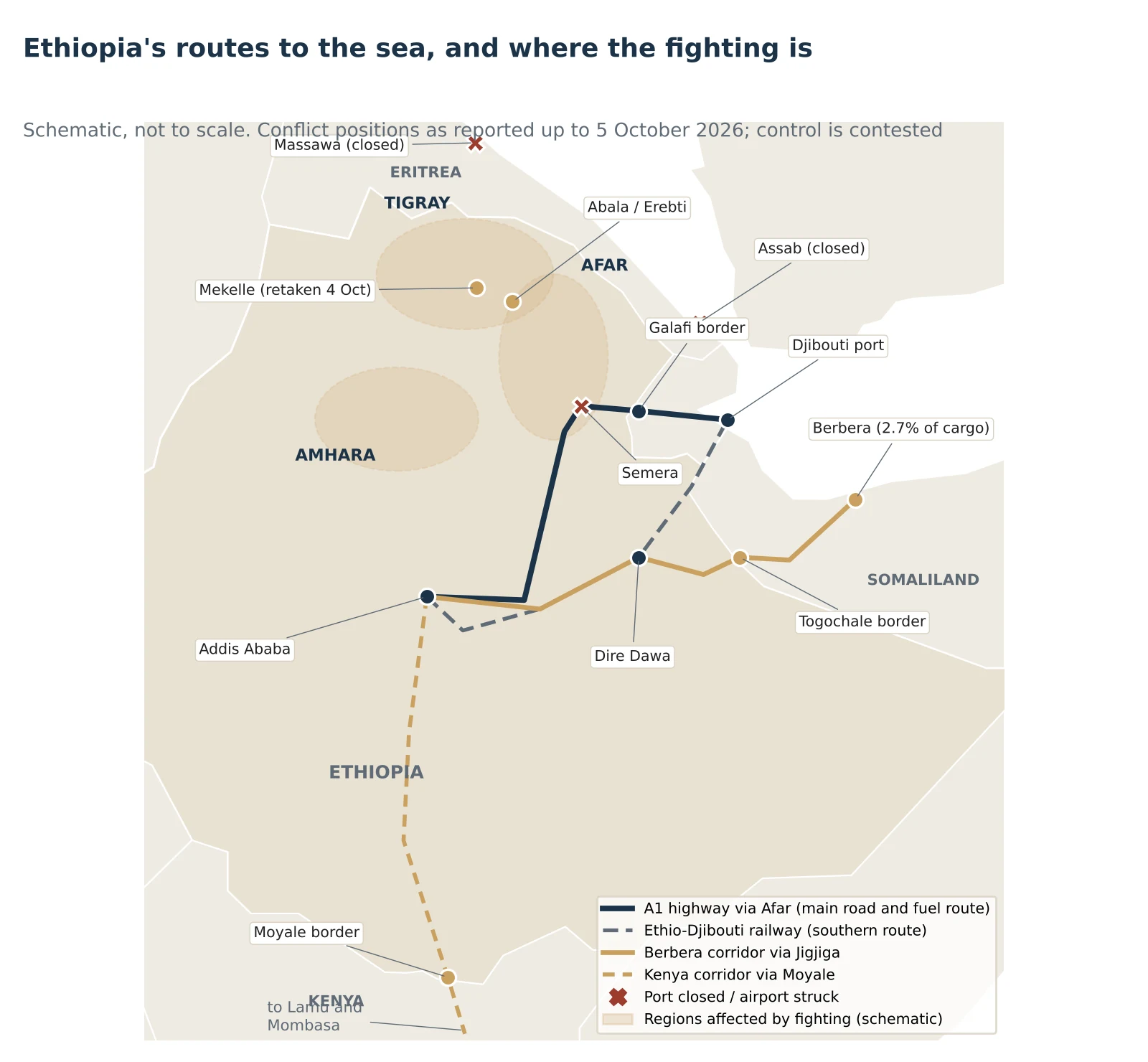
That matters most in Afar. In late September Tigrayan forces took Erebti and Abala, towns on a secondary road that joins the main highway from Djibouti near Semera, and pushed east. Federal forces said they had retaken both on 1 October. Afar's regional governor has accused Eritrean troops of fighting across much of the region, telling Al Jazeera's Arabic service that Afar was facing "Eritrea with its generals and weapons"; Eritrea has not accepted the claim. Euronews reported that the Djibouti corridor remained open, while analysts quoted in English- and Arabic-language coverage read the Afar offensive as an attempt to gain a hold over it.
One road, almost all the trade
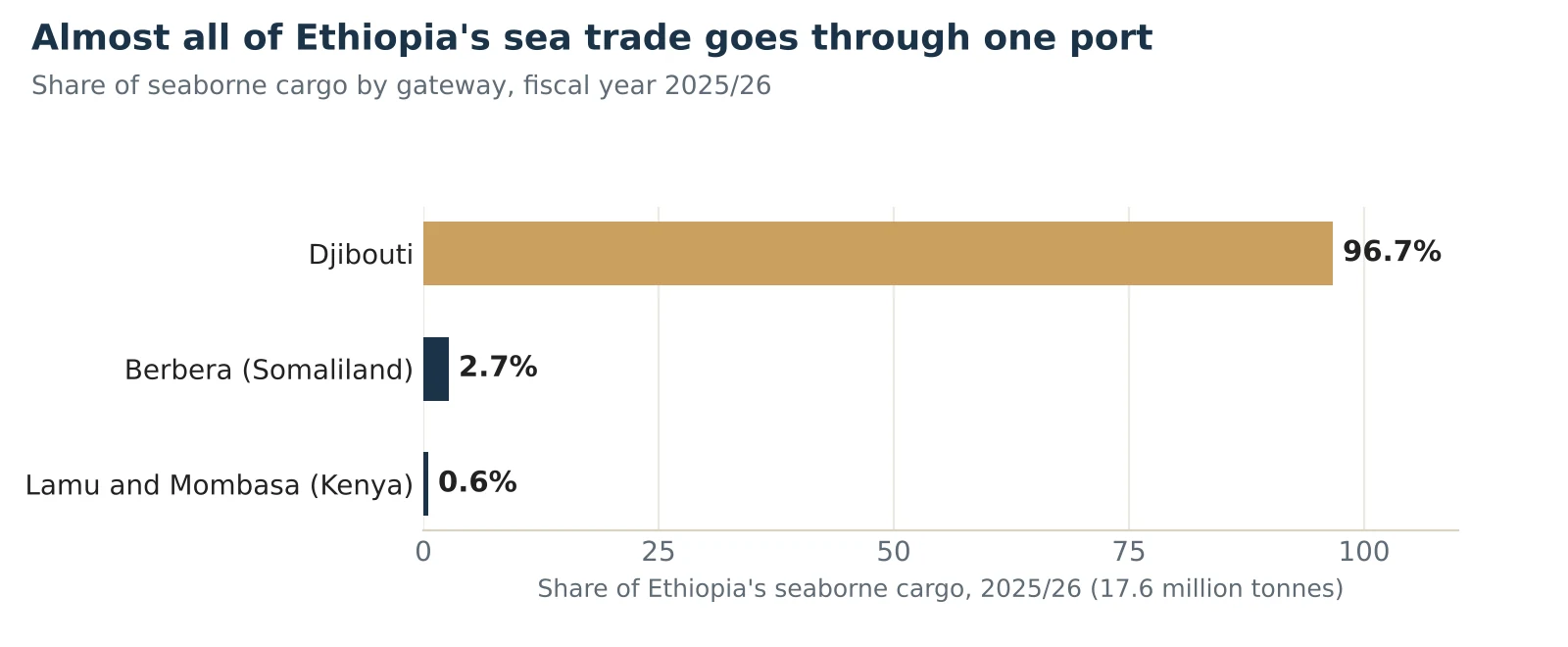
Ethiopia is landlocked. In the 2025/26 fiscal year, according to figures reported by Addis Standard, 96.7% of its seaborne cargo, about 15.3 million of 17.6 million tonnes, moved through Djibouti. Berbera in Somaliland handled 2.7%, and Kenyan ports 0.6%. Almost all the country's fuel arrives by truck on the Djibouti corridor.
The corridor was already under strain before the war resumed. In April a fuel shortage, caused by the conflict in the Gulf, left Ethiopian trucks queuing at fuel stations, and Djibouti port officials reported far fewer of them arriving to collect cargo. Truckers now describe round trips between Djibouti and Addis Ababa of 15 to 30 days, and the drivers' association has asked employers for higher allowances after prices for food and basics in Djibouti rose by up to 45% in September.
Beyond Djibouti, the sea route has become more expensive too. In September Houthi forces were reported to have taken the Yemeni port of Mokha and nearby islands at the mouth of the Red Sea, and war-risk insurance premiums for Red Sea transits rose from about 0.1% of a ship's value to between 0.7% and 1%, according to industry figures reported in Ethiopian media. Ships that divert around the Cape of Good Hope add 10 to 15 days, and Ethiopian coffee exporters have described delivery times doubling since the Red Sea crisis began. Ethiopian businesses are now exposed at both ends of the same supply chain.
The economy has less room to absorb this than its growth figures suggest. The IMF projects growth of more than 9% this year, but inflation climbed back to 15.3% in July after fuel price rises, and the birr traded at around 155 to 163 to the dollar officially against 174 to 180 on the parallel market.
If the road closes: what are the alternatives?
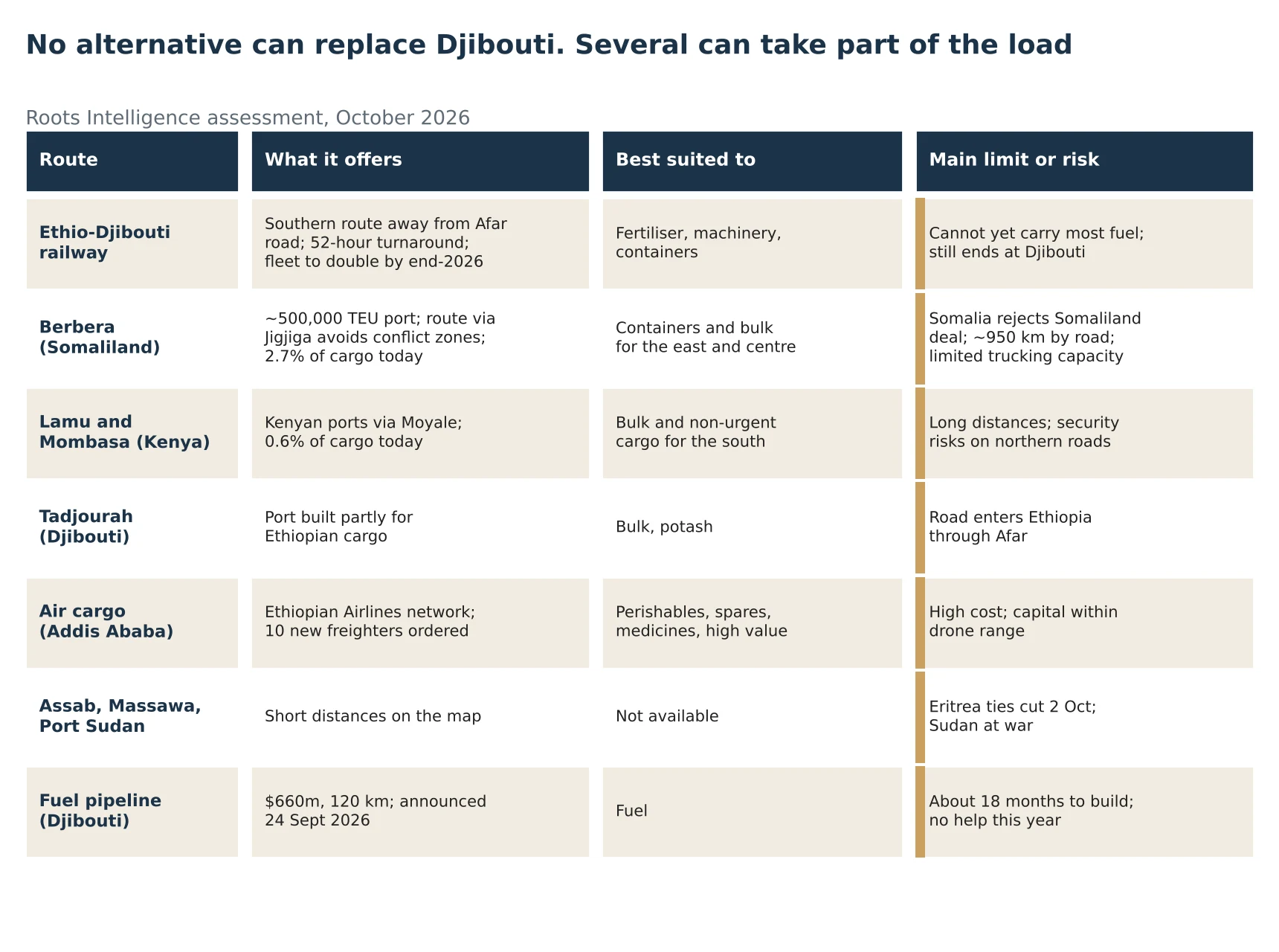
If the conflict continues and the A1 through Afar becomes unreliable, companies will look for other routes. None of them can replace Djibouti at scale. Each can take part of the load, and each brings its own risk.
The railway. The electric Ethio-Djibouti railway runs further south, through Adama and Dire Dawa, away from the northern Afar road. It already carries fertiliser and machinery, cut its turnaround to 52 hours during the April fuel shortage, and plans to double its fleet of 1,100 wagons and 35 locomotives by the end of the year. A rail link to the Horizon fuel terminal at Doraleh is under construction, but rail cannot yet carry most of the country's fuel.
Berbera. DP World's port in Somaliland, about 950 kilometres from Addis Ababa by road through Jigjiga and the Togochale border, has container capacity of around 500,000 TEU and a route that avoids the conflict zones entirely. It carried only 2.7% of Ethiopia's cargo last year. Logistics specialists have said a shift of even 10% would be a major achievement. The political risk is high: Somalia rejects Somaliland's independence, opposed the 2024 Ethiopia–Somaliland agreement, and signed the 5 October declaration insisting Ethiopia may use ports only through negotiation.
Kenya. Lamu and Mombasa, reached through Moyale, have handled fertiliser shipments for Ethiopia and took 0.6% of its cargo last year. The distances are long and parts of the road through northern Kenya carry their own security risks, so the route suits bulk and non-urgent cargo.
Djibouti's other ports. Tadjourah was built partly for Ethiopian cargo, but its road reaches Ethiopia through Afar, the same region now contested. It adds little security.
Routes that are closed. Eritrea's ports at Assab and Massawa are shut to Ethiopian trade after the break in relations, and Port Sudan is not a realistic option while Sudan's own war continues.
Air. Ethiopian Airlines' suspensions have so far been limited to northern domestic airports, and on 2 October the airline ordered ten Boeing 777 freighters. Air cargo can move high-value goods, medicines, spare parts and perishables such as flowers, at high cost. The drone strikes on the capital are a reminder that the airport is not beyond the conflict's reach.
A $660 million fuel pipeline from Djibouti, announced on 24 September, would reduce the dependence on fuel trucks, but it is expected to take 18 months to build and does not change the next year.
What happened last time
The 2020 to 2022 war is the best guide to the commercial consequences, and many of them were indirect. In November 2021 Tigrayan forces advanced south through Amhara towards the highway and the capital, and several governments told their citizens to leave. The United States then suspended Ethiopia's duty-free access under the African Growth and Opportunity Act from January 2022, citing human rights abuses. According to figures later reported by The Reporter, the suspension cost more than 11,500 jobs and saw 18 foreign companies leave the industrial parks, including 2,885 jobs at the park in Mekelle.
Sanctions followed too. In September 2021 Washington created a sanctions framework for the northern Ethiopia conflict and used it that November against Eritrea's armed forces and ruling party. That framework expired in September 2026, and the Eritrean designations were lifted just as fighting resumed. Any new US or EU measures would need new authority and could arrive with little warning.
The largest losses for foreign companies in 2021 did not come from damage on the ground. They came from trade access, sanctions, reputational exposure and staff evacuations, and they arrived months after the fighting began.
The risks to watch, by function
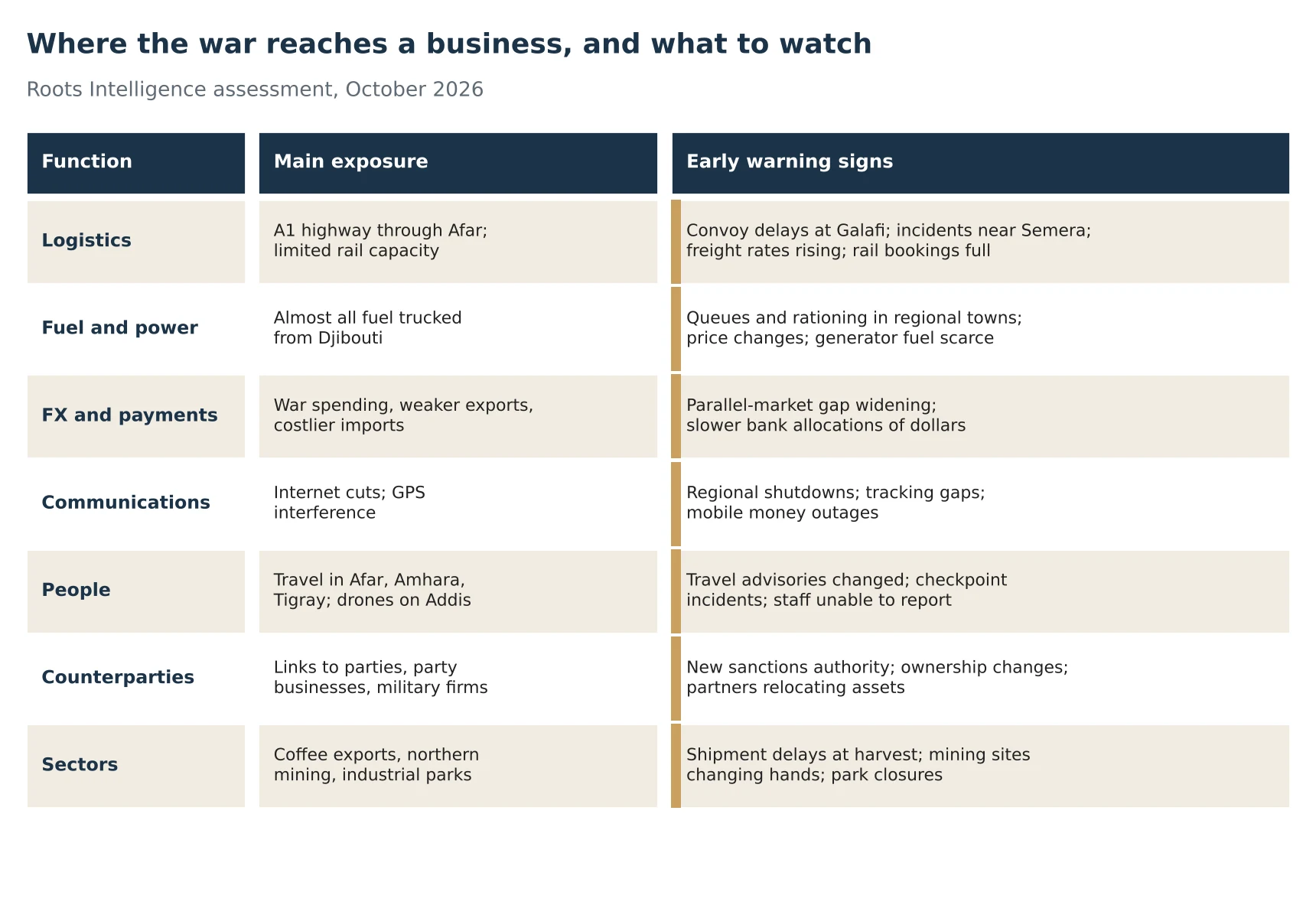
Logistics. Incidents on the A1 between Semera and the Galafi border, convoy security, rail capacity, and freight and insurance costs on the Red Sea leg.
Fuel and power. Shortages show up first as queues and rationing in regional towns, then in transport costs, generators and cold chains.
Foreign exchange and payments. War spending, weaker exports and costlier imports point towards a wider parallel market gap and slower access to dollars for importers.
Communications. Internet and phone services have been cut across Tigray, and GPS interference consistent with jamming was reported around Addis Ababa in late September. Both affect fleet tracking, payments and staff safety.
People. Travel in Afar, northern Amhara and Tigray is restricted, and the drone strikes show that the capital is no longer outside the conflict.
Counterparties. Companies with owners or partners linked to any party to the conflict, including businesses affiliated with the TPLF's former endowment network or with state military enterprises, carry legal and reputational risk that can change overnight.
Sectors. Coffee is grown mainly in the south and west, away from the fighting, but the harvest starts this month and leaves on the same corridor and the same sea route. Mining in Tigray and Afar, including the potash area around Dallol where fighting was reported in late September, and the northern industrial parks are directly exposed.
Three ways the next months could go
These are conditions to watch, not predictions.
If federal forces consolidate control of Tigray and the Afar roads, and the rebel groups remain divided, the likely result is a long insurgency with periodic attacks on roads, towns and infrastructure. Business continues, with higher security and logistics costs.
If rebel forces hold parts of Afar or northern Amhara and can strike the A1 repeatedly, the corridor becomes unreliable. Expect fuel rationing, longer delivery times, more traffic forced onto rail and Berbera, and pressure on the birr.
If Eritrea, Egypt or Sudan become directly involved, the conflict becomes regional. Air routes, Red Sea shipping, the Berbera option and insurance would all be affected, and Western sanctions or trade measures would become more likely.
What companies should do now
- Map your corridor exposure. Identify every input and output that moves on the Djibouti road, which could move by rail, Berbera, Kenya or air, and at what cost. Hold larger buffer stocks of fuel and critical inputs.
- Pre-arrange alternatives. Rail bookings, a forwarder with experience of the Berbera route, and air cargo capacity are much easier to secure before a closure than during one.
- Check counterparties against the parties to the conflict. Ownership links to armed groups, party-affiliated businesses or military enterprises need to be known before a sanctions decision, not after.
- Set a policy on checkpoints. Informal payments at checkpoints controlled by armed groups can raise sanctions and terrorist-financing questions. Decide in advance what drivers and contractors may pay, and record it.
- Review contracts and cover. Force majeure clauses, war-risk exclusions, and the gap between insured physical damage and uninsured delay.
There are limits. Information from conflict areas is slow, partial and contested, every party has reasons to exaggerate, and remote monitoring loses most of its value when the internet is cut. Some of these risks cannot be reduced, only priced.
Reading the corridor from the ground
Ethiopia's information environment makes this harder than usual. In February the Ethiopian Media Authority revoked the licence of Addis Standard, one of the country's main independent outlets, and of the independent broadcaster Wazema Radio; Reuters journalists' accreditations were not renewed, and Deutsche Welle's local correspondents were suspended last October. Reporters Without Borders now ranks Ethiopia 148th in the world for press freedom. What remains is state media that reflects the government's line, party-affiliated media on the other side, private outlets that report carefully, and independent outlets publishing from abroad or under legal threat.
In that environment, the early signals of corridor trouble come from people, not statements: truck drivers waiting at Galafi, fuel depot managers in Semera, traders in Dire Dawa watching prices, forwarders deciding whether to send convoys north this week. When the internet goes down in a region, they are often the only reliable source of what is happening there. Their reports, checked against conflict data, satellite imagery, shipping and flight records, are what separate a rumour from a closure.
Mekelle changed hands in a day. The road to Djibouti will decide how long this war costs everyone else.
Position as at 5 October 2026. Claims by the parties to the conflict are described as reported and have not been independently verified. This article does not constitute legal advice.