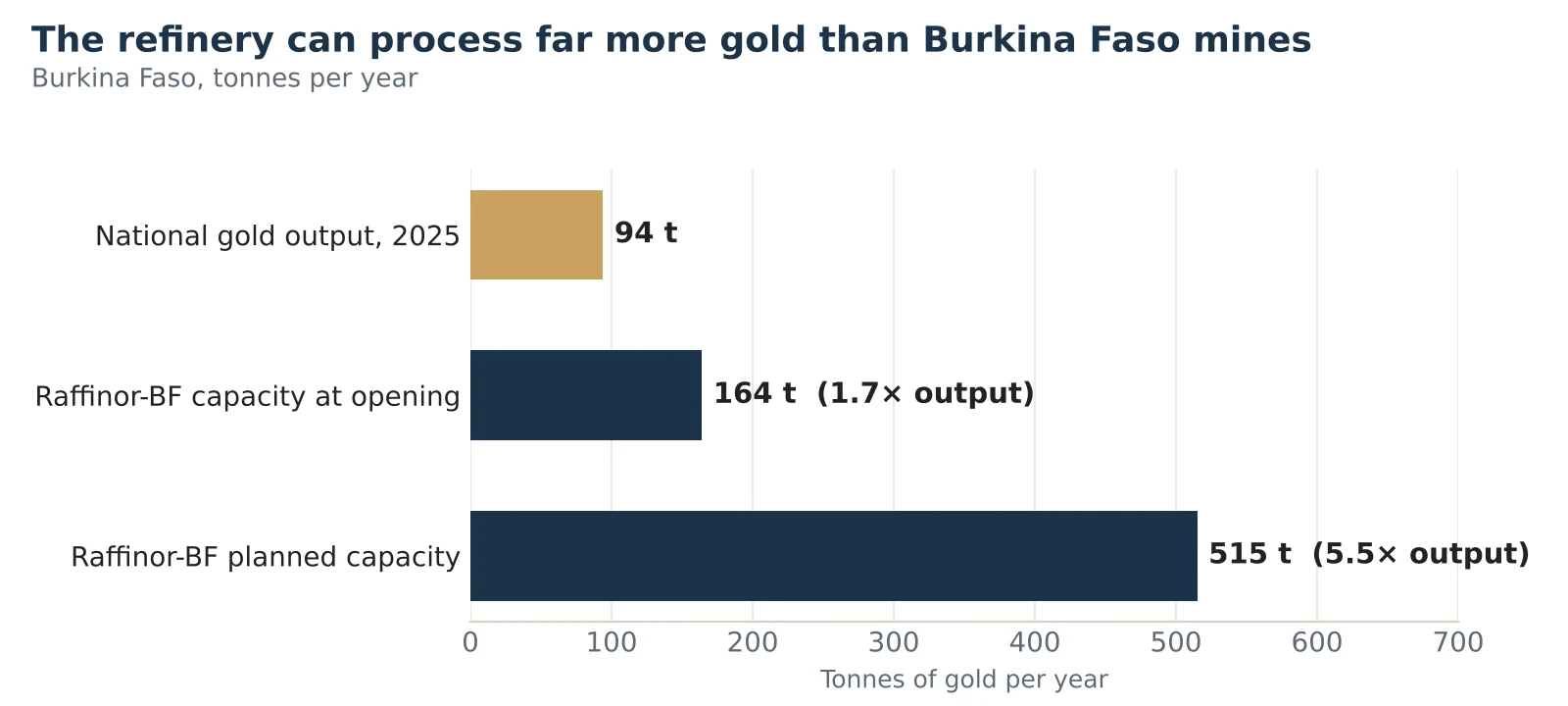
Raffinor-BF opened in Ouagadougou on 28 September with room to refine 164 tonnes of gold a year. Burkina Faso produced 94 tonnes in 2025. For anyone who buys African gold, the distance between those two numbers has just become a due diligence question.
A refinery built for more than one country
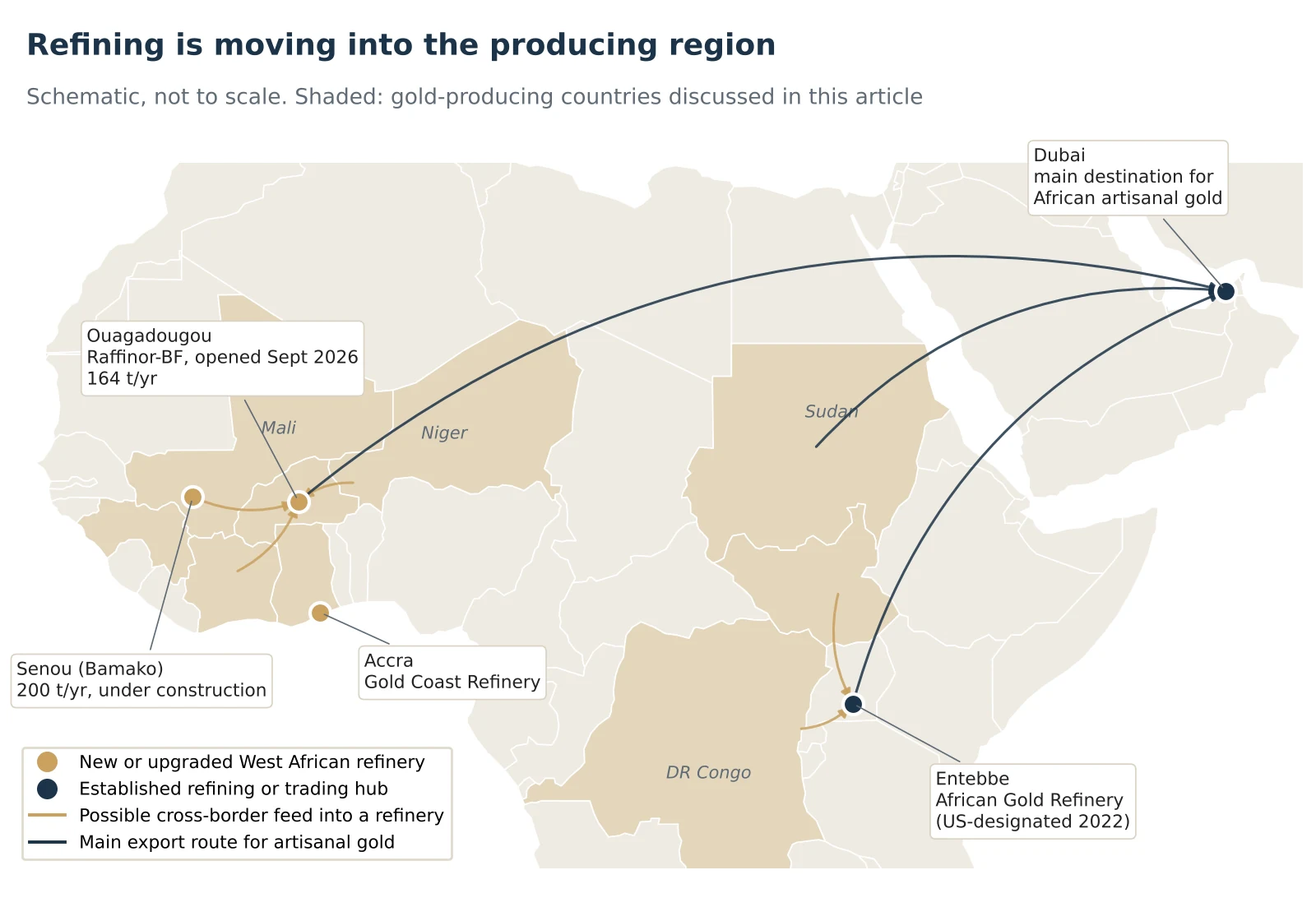
Captain Ibrahim Traoré cut the ribbon on Monday 28 September. The plant cost 11 billion CFA francs, about $19 million, and is run by a state precious metals company with private Burkinabè partners whose names have not been published. It will assay, refine, certify and store gold. Its initial capacity of 164 tonnes a year is roughly 1.7 times what the whole country produced last year, and officials have said they want to take it to 515 tonnes, with gold from neighbouring countries in mind.
"We want to refine all our metals on site," Traoré said at the opening. "We want to have the entire value chain on site."
Burkina Faso is not alone. Mali broke ground on a 200-tonne refinery at Senou, outside Bamako, in June 2025, with Russia's Yadran Group as partner. Yadran's president described it as a future regional centre for gold mined "not only in Mali, but also in neighbouring countries". Ghana's Gold Coast Refinery is being brought up to international standard under the supervision of South Africa's Rand Refinery, and since 1 September Ghana has required artisanal gold doré bought by licensed aggregators to be refined in the country before it can be exported. Guinea and Côte d'Ivoire are pursuing similar plans.
Why the location of a refinery matters
The reasons governments give are real. For decades almost all West African gold left as doré or as unrefined artisanal gold and was refined in Dubai, Switzerland or South Africa, so refining fees and much of the margin left with it. Smuggling cost the treasuries of the region billions of dollars a year. Burkina Faso's government also says openly that illicit gold trading finances the armed groups it is fighting. A domestic refinery, fed by state buying counters, is meant to pull that gold into a channel the state can see and tax.
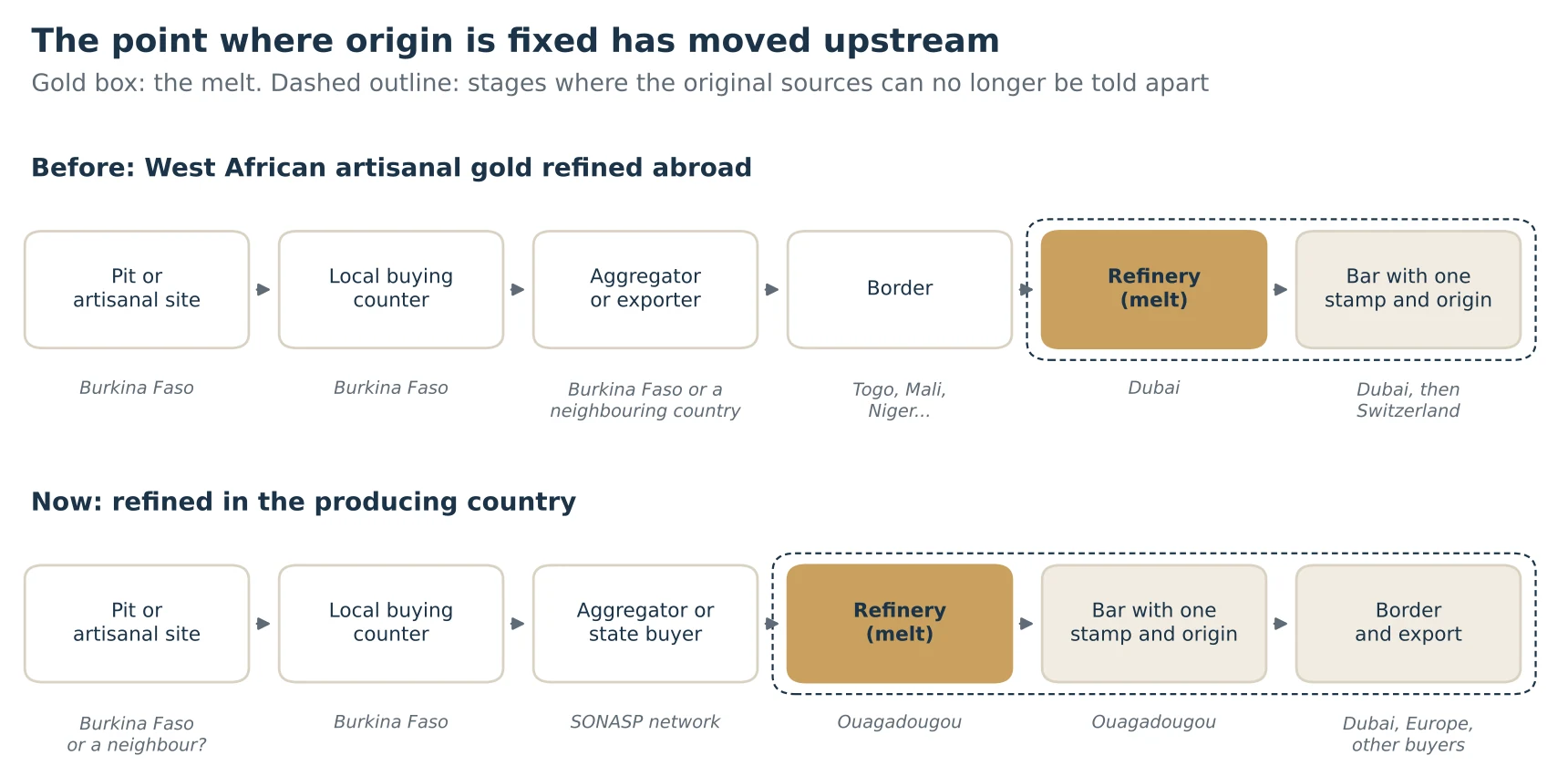
There is a less discussed consequence. A refinery is where gold from different sources is melted together and becomes a bar with a single stamp and a single declared origin. Once that has happened, no assay can say which mine any part of the bar came from. Whatever is known about origin has to be established before the melt, from the people and paperwork that brought the gold in.
Until now, for most West African artisanal gold, that point sat in Dubai. Gulf refiners have been under OECD-aligned due diligence rules since January 2023, under audit, and under growing pressure from buyers in Switzerland and London. Buyers built their checks around them. With refining moving to Ouagadougou, Bamako and Accra, the point at which origin is fixed moves to refineries with no operating history, no international accreditation yet, and in Burkina Faso's case, undisclosed private partners. A refinery needs several years of operating history before it can apply to join the LBMA Good Delivery List, so none of the new plants will have that assurance for some time.
The capacity figures make the feedstock question unavoidable. A plant sized at 1.7 times national output, with plans to reach five times, will run well below capacity, or it will refine gold from elsewhere. Neither is wrong in itself. Regional refining could bring artisanal gold from Niger or Mali into a regulated channel that would otherwise end in a smuggler's bag. But a buyer of a bar stamped in Ouagadougou will need to know which of those happened, and in what proportions.
What the numbers show, and what they don't
Burkina Faso's own figures already show how quickly the picture can change. In the first nine months of 2025, the state collected 29.6 tonnes of artisanal gold, against 5.6 tonnes in the same period of 2024. Industrial output barely moved, from 39.2 to 40.9 tonnes. Full-year production reached a record 94 tonnes.
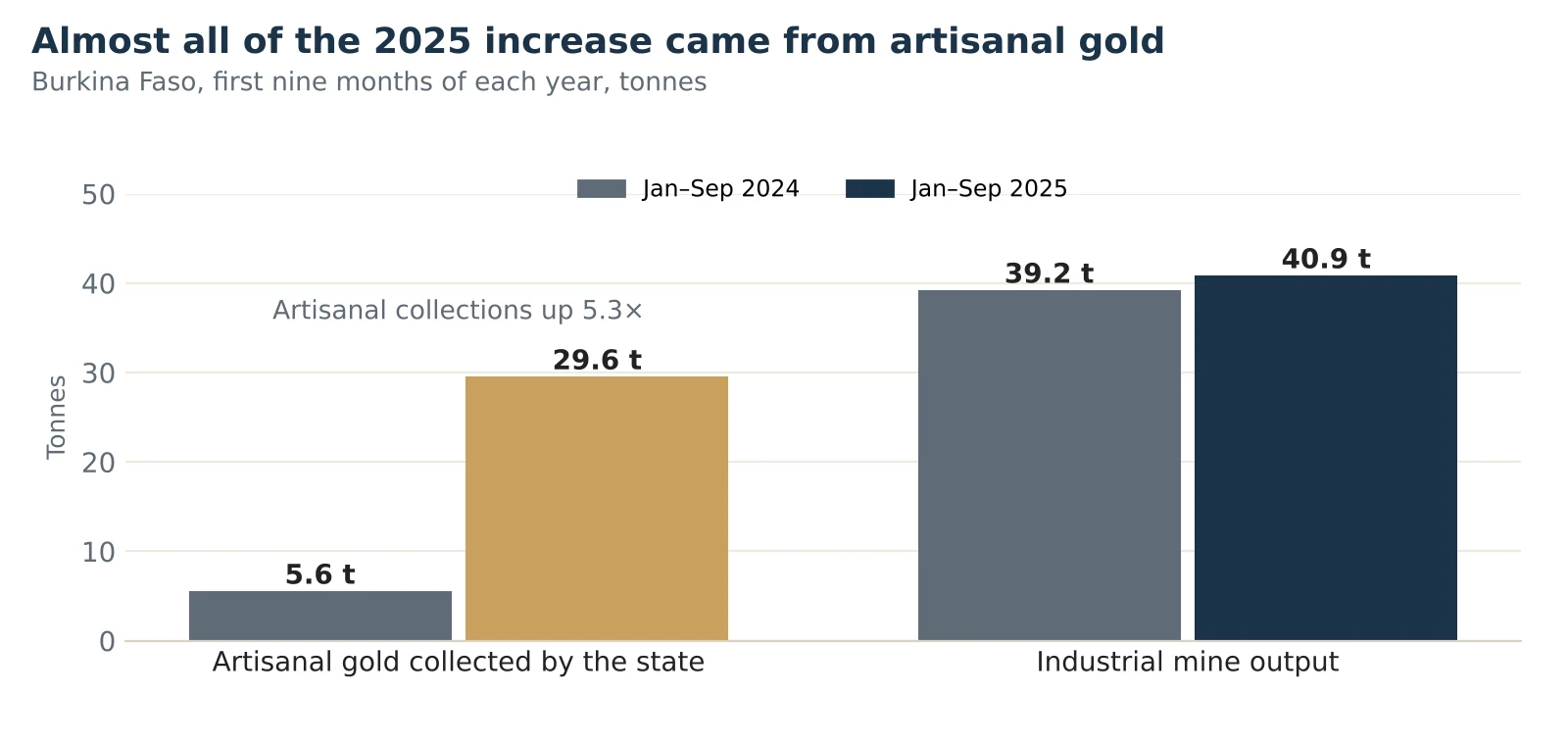
The official explanation is formalisation: the state's buying network, SONASP, opened counters across the country after artisanal exports were suspended in 2024, and gold that used to leave informally is now sold to the state. That is plausible, and it is consistent with what governments across the region are trying to do. It is not the only possible explanation. Some of the increase could be gold produced in neighbouring countries and sold across the border where prices or payment terms were better. The published figures cannot separate the two. That is exactly the question a refinery's customers will inherit.
Gold that crosses borders before it is declared is not a theoretical concern. SWISSAID estimated that more than 435 tonnes of African artisanal gold left the continent undeclared in 2022, the last year it measured, and that most of it went to the United Arab Emirates. Uganda shows how a country can become a gold hub without being a big producer: its gold exports reached $5.8 billion in 2025, up 76% on the year before. At 2025 average prices that is roughly 50 tonnes. Uganda's first industrial gold mine is designed to produce about 1.2 tonnes a year.
Three refineries that show where the risk sits
African Gold Refinery, Uganda. In March 2022 the US Treasury designated the Entebbe refinery and its owner, Belgian businessman Alain Goetz, for allegedly refining gold from mines in eastern Congo controlled by armed groups, around 8.5 tonnes a year worth $496 million. The refinery sat in a country that mines little gold of its own. Its feedstock came across a border, from places its customers could not see.
Valcambi and Kaloti. In 2020, Swiss inspectors found that Valcambi, one of the world's largest refiners, was still receiving gold from a Dubai refinery belonging to the Kaloti group, which a confidential Swiss document linked to money laundering. The findings were reported by Swissinfo in 2023, and Valcambi has disputed parts of the account. No penalty followed, because Swiss law provided none, but the reporting reached Valcambi's downstream customers, among them some of the best-known names in consumer electronics. The damage came from not knowing what an upstream refinery was buying.
The UAE suspensions. In 2024 the UAE Ministry of Economy suspended 32 gold refineries for three months after inspections found more than 250 compliance violations. The rules were in place. Following them is a separate matter, and buyers had relied on the rules.
Consider a hypothetical case. A jewellery manufacturer in Italy is offered kilobars from a new West African state refinery at a small discount to London prices, with full assay certificates and an export licence. Every document is genuine. The manufacturer's due diligence confirms the refinery is state-owned, licensed and not sanctioned. What those checks cannot show is how much of the refinery's input came from a Malian border town the previous month, or whether any of it came from Sudan, which since July has been a matter of EU sanctions law rather than reputation. The EU now prohibits buying gold that originated in Sudan and left the country after 15 July 2026, even when it has passed through a third country.
What due diligence should do about it
For refiners, bullion dealers, banks and manufacturers who will be offered gold from the new refineries, the checks shift from the refinery's paperwork to its supply.
- Ask for the feedstock mix, by month. Industrial doré, domestic artisanal gold and imported material should be reported separately, with volumes. Compare them against national production statistics. Input that exceeds what the country plausibly produces is the first thing to explain.
- Identify the partners. Find out who owns, operates and supplies technology to the refinery, and who buys its output. Screen them against sanctions lists, check for politically exposed persons, and look at their record in other markets.
- Map the import rules. Find out whether the refinery accepts foreign doré, from which countries, and with what documents. Exposure to Sudan, Mali, Niger or eastern Congo changes the risk rating immediately.
- Watch the price. If a refinery's buying counters pay more than counters across the border, gold will move towards it. Price differences between neighbouring markets are one of the clearest early signals of cross-border flows.
- Ask which standard it will be audited against, and when. An OECD-aligned independent audit is the minimum to expect before significant volumes are bought.
There are limits. Once gold has been melted, nobody can trace it physically, so all of this has to happen at the point of supply. State refineries may not grant access to outside auditors. Insecurity across much of northern and eastern Burkina Faso, and in central Mali, limits where anyone can travel. Some of these questions will stay partly unanswered, and the decision then is whether the remaining uncertainty is acceptable for the volume involved.
Knowing the market around the refinery
Most of the questions above can't be answered from Geneva, Dubai or London. They depend on what happens at a buying counter in Kaya or Essakane, on what a trader in Sikasso is being paid this month compared with a trader across the border, and on who has started selling to the state network and why. Prices, routes and the names of the middlemen change faster than any statistic is published.
People who work in those markets can test a refinery's account of its own supply: whether the volumes it reports match the activity around its counters, whether new sellers appear after a price change across the border, whether a supplier who claims domestic production can actually reach the sites it names. That doesn't replace audits or documents. It tells a buyer whether the audits and documents describe what is actually happening.
Refining at home keeps more of the value in the producing country. It also keeps the origin question there, in places most buyers have never had to look.
Position as at October 2026. Allegations and designations are described as reported by the authorities named. This article does not constitute legal advice.